
Realistic 2026 Moving Costs in Miami: Local, Condo & Long‑Distance
See what people actually pay to move between Miami neighborhoods and out of South Florida in 2026, then use an AI home scan on MoveCost.ai to turn your own inventory into accurate estimates and mover quotes.

moving cost in Miami, FL
Your 2026 Miami Moving Cost Hub (Not Just Another Quote Page)
This page is designed to be the central 2026 moving cost hub for Miami. You’ll find: • Typical price ranges for local Miami moves by home size and neighborhood • Example cost patterns on popular routes out of Miami, like Miami→Orlando, Miami→Atlanta, and Miami→New York/Texas • A breakdown of how elevators, parking, and building rules in areas like Brickell, Downtown, South Beach, and Little Havana affect price • How hurricane season and snowbird timing in 2026 can push quotes up or down Other Miami pages on MoveCost.ai have different roles: • Moving Quotes in Miami, FL focuses on collecting and comparing written quotes once you’re ready to talk to movers. • Moving Estimate in Miami, FL explains how inventory-based estimates are structured and how to read them. • Local Movers in Miami, FL helps you choose between local crews for short routes between neighborhoods. • Long Distance Movers from Miami, FL is for state-to-state routes starting in South Florida. This page sits on top of that cluster as the cost breakdown hub. It’s where you: 1. Get oriented on what a realistic 2026 budget looks like for your type of Miami move. 2. See how your situation compares to common local and long‑distance patterns. 3. Then click into quotes, estimates, and tools with a clear cost baseline in mind. Once you’re familiar with the ranges here, you can run a free AI scan to turn your own Miami home into an inventory—and see how your specific cost compares to these 2026 benchmarks.
Typical 2026 Moving Costs in Miami: Fast Snapshot
These ballpark 2026 ranges reflect what many Miami residents report paying movers for standard jobs when they’re not adding full packing or storage. Your actual quote will move up or down based on access, timing, and how much you own. • Smaller local move (studio or light 1BR) Short route like Brickell → Downtown or Edgewater → Midtown with decent elevator access: · Often lands somewhere around $350–$800 in 2026 when there are no major surprises. • Typical 1–2BR condo/apartment local move Moves like South Beach → Brickell, Little Havana → Coral Gables, or Midtown → Wynwood: · Many land between $450–$1,600 depending on floor level, elevators, hallway distance, and how full the unit is. • 3BR+ local house or townhouse move within Miami‑Dade For example Kendall → Doral, Westchester → Cutler Bay, or Miami Shores → North Miami: · Frequently falls in the $1,400–$2,500+ range when including a full truck and several hours of labor. • Longer in‑state moves (e.g., Miami → Orlando/Tampa/Jacksonville) For modest 1–2BR shipments: often low four‑figure totals once transport, labor, and route are factored in. Larger 3BR+ shipments with packing can move into the mid four‑figure range. • Common outbound long‑distance moves (Miami → Northeast, Texas, Midwest, West Coast) One‑bedroom or compact 2BR condos sharing truck space often fall somewhere in the low to mid four‑figures. Full 3–4BR homes headed out of state commonly land in the higher four‑figure to mid five‑figure band once distance and services are included. These aren’t promises or fixed rates; they’re reference points. The rest of this page explains what usually moves you toward the low or high end of those 2026 ranges—and how an AI scan lets Miami movers price your situation more precisely.
2026 Local Miami Moving Cost by Home Size & Neighborhood Type
Local moving companies in Miami almost always care about two things: how much you have and how hard your buildings and streets are to work with. Below are illustrative 2026 ranges that show how the same size home can behave differently in different parts of Miami. 2026 Local Miami Moving Cost – Typical Ranges (Labor + Truck, Packing Extra) | Home Type & Area (Illustrative) | Access / Notes | Many 2026 Moves Fall Around* | |-----------------------------------------------------------------------------|-------------------------------------------------------------------------------|-------------------------------| | Studio in Brickell / Downtown high‑rise | Freight elevator reserved, loading dock on‑site, short hallway carries | $350–$650 | | Studio / 1BR in South Beach walk‑up | 2–3 flights of stairs, street parking, longer walks | $400–$800+ | | 1BR condo in Edgewater / Midtown with service elevator | Garage or dock parking, moderate elevator wait | $450–$900+ | | 2BR in Little Havana / older Coral Way walk‑up | 2–3 stair flights, tight stairwells, limited loading zone | $800–$1,600+ | | 2BR townhouse in Doral / Kendall with driveway | Easy truck access, a few interior stairs | $750–$1,400+ | | 3BR house in Kendall / Westchester / Cutler Bay | Driveway parking, garage/patio items, some larger furniture | $1,400–$2,500+ | | 3BR condo in Brickell / Sunny Isles high‑rise | Freight elevator bookings, longer corridors, strict HOA rules | $1,600–$2,800+ | \*These 2026 ranges are examples built from typical jobs and assume a same‑day, in‑metro move with standard furniture, no full‑service packing, and no unusual access emergencies. Use these tables to sanity‑check quotes: • If a 2BR Brickell high‑rise quote is far below the low end and doesn’t mention elevators or docks, dig into the fine print. • If a simple 1BR with easy driveway parking in Kendall is quoted way above the upper range without extras, ask what’s driving the number. Then run an AI scan so local movers are using your exact inventory and building conditions, not the approximate examples above.
What 2026 Moves From Miami to Key Cities Tend to Cost
MoveCost also sees consistent patterns on popular outbound routes from Miami. The ranges below are illustrative only, but they show how distance bands and inventory change your 2026 budget. Example 2026 Route Patterns (Based on Typical Inventories & Conditions) • Miami → Orlando / Tampa / Jacksonville (shorter in‑state) · Light 1BR / studio with modest furniture: often in the low four‑figures once all line items are added. · Full 2–3BR homes with more furniture and garage/patio items: often mid four‑figures, especially with packing. • Miami → Atlanta / Charlotte / Southeast hubs · Routes around ~600–700 driving miles. · Smaller AI‑scanned loads often in lower to mid four‑figure territory. · Larger 3–4BR loads with full furniture and some packing can climb toward upper four‑figures. • Miami → New York / New Jersey / Northeast · Common long‑distance interstate corridor, often ~1,250–1,350 miles. · Shared‑truck 1–2BR shipments often in the mid four‑figure band. · Full 3–4BR households, especially from houses or large condos, regularly land in the higher four‑figure to mid five‑figure range depending on services. • Miami → Texas (Houston/Dallas/Austin) or Midwest · Typically ~1,300–1,500+ miles. · Pricing behaves similarly to Miami→Northeast but responds to route demand and season. · Again, smaller inventories keep things in the low/mid four‑figure band; big 3–4BR homes with packing can extend beyond. For 2026 planning: • Use this page to understand how your route category behaves. • Then open the State to State Moving Cost Calculator Online or Moving Cost Calculator by State and City to test your exact origin/destination combo with your AI inventory. • Finally, when you’re confident you’re leaving the state, open Long Distance Movers from Miami, FL to compare actual mover estimates grounded in that same inventory.
Distance vs Traffic vs Building Access: What Really Drives 2026 Miami Prices
In many U.S. cities, distance is the biggest factor in moving cost. In Miami, distance, traffic, and building access share the spotlight. • A short Brickell → Edgewater move might take longer than a Kendall → Doral move if: • The Brickell building has a tight elevator window and shared loading dock. • Parking is farther from the unit. • Biscayne Boulevard traffic is heavy at your start time. • A South Beach → South Beach move may still take hours if: • Street parking is scarce and the truck has to circle or stage farther away. • There are multiple stair flights in older walk‑ups. • There’s heavy weekend event traffic. Your AI inventory explains the “how much”, and your building/parking notes explain the “how hard”. On MoveCost, your cost breakdown reflects: • Estimated hours for loading and unloading, based on your item list and whether there are stairs, elevators, tight halls, or long carries. • Estimated drive time, using realistic 2026 traffic expectations for your route band, not just clean map distance. • Adjustments for truck size and parking—for example, if you’re in a low‑clearance garage and need a smaller vehicle. That’s why this cost hub repeatedly emphasizes stairs, elevators, and docks alongside miles: they define how long crews will be earning their hourly rate in real 2026 Miami conditions.
How AI Inventory Makes 2026 Miami Moving Costs Less of a Guess
Two Miami neighbors in identical floor plans can see very different moving bills in 2026 because of what’s inside: • Neighbor A in Brickell has a simple loveseat, platform bed, a few lightweight shelves, and 15 boxes. • Neighbor B has a heavy sectional, solid wood bedroom sets, glass dining table, patio set, grill, bikes, and 40+ boxes. Both might tick the same box on a basic calculator—“1‑bedroom, elevator”—but movers will have a very different day at each unit. MoveCost’s AI scan is designed specifically to fix that: 1. You walk your Miami place with your phone. The AI identifies couches, beds, tables, dressers, TVs, and box clusters, and approximates volume. 2. You add context: which items are heavy, fragile, need disassembly, or sit on a balcony or in a garage. 3. The platform turns that into a structured inventory used across all your Miami tools: cost breakdowns, estimates, quotes, local movers, and long‑distance movers. Effects on your 2026 cost: • Quotes that under‑ or over‑estimate truck size become less likely. • Hourly estimates are tied to a known volume and item list, not a generic room count. • Special items (glass tables, large TVs, treadmills, pianos) are flagged in advance, so you can see if they add handling time or cost. When you move from this cost page into Moving Quotes in Miami or Moving Estimate in Miami, the AI inventory becomes the common language connecting your cost expectations with movers’ day‑of‑work reality.
2026 Seasonality in Miami: When Moving Costs Tend to Peak
In 2026, just like past years, Miami moves will be shaped by heat, rain, hurricane season, and snowbird timing. Seasonal Patterns to Keep in Mind • Late Spring to Early Fall (roughly May–September) · High demand from families, new leases, and relocations. · Heat slows work on stairs and long carries. · End‑of‑month weekends often carry higher rates or book up fastest. • Hurricane Season (typically June–November) · Active systems can force last‑minute schedule changes or elevator restrictions. · Some buildings temporarily halt moves during strong storms. · Movers may build a little extra slack into schedules, which can influence pricing. • Snowbird & Peak Event Periods · In and around South Beach, Brickell, and Downtown, some peak tourist and event weeks complicate parking and loading. · Weekdays may be priced differently than weekends when loading docks, elevators, and streets are busiest. 2026 Date and Time Choices On MoveCost, you can plug in multiple preferred windows for 2026 (for example, “late May weekday morning” vs “first Saturday in June”) and see how movers respond: • Some may offer lower rates or more optimistic timing for midweek, off‑peak slots. • Others may recommend larger crews for hot, busy days to keep within building rules. Using this cost hub together with the Local Moving Cost Calculator Near Me and Moving Quotes in Miami pages lets you see how shifting your date or time by even a little in 2026 can change your local or long‑distance budget.
Local vs Long‑Distance from Miami: How 2026 Pricing Models Differ
The same AI inventory can support two very different pricing models in 2026 depending on your route: Local / In‑Metro Miami Moves Used for routes like Brickell → Midtown, Coral Gables → Coconut Grove, Kendall → Doral, etc. • Usually hourly pricing for a crew + truck • Minimum hours (often 2–4) with time added as needed • Access (stairs, elevators, parking, loading docks) heavily influences total time Longer In‑State or Interstate Moves Used for routes like Miami → Orlando/Tampa/Jacksonville, Miami → Atlanta, Miami → New York/Texas, or cross‑country. • Often based on volume/weight + distance • Delivery windows vary by distance band and season • Access still affects how long loading and unloading take, but the driving portion becomes a larger share of the bill On MoveCost: • This Moving Cost in Miami hub helps you understand which band you’re in and what 2026 ranges look like. • Local Movers in Miami, FL and Moving Quotes in Miami, FL focus your AI inventory on short‑distance, hourly‑based jobs. • Long Distance Movers from Miami, FL and the State to State Moving Cost Calculator Online apply the same inventory to distance‑based models used for longer routes. Understanding which model applies before you compare movers keeps you from weighing an hourly local quote against a flat long‑distance bid without context.
From 2026 Cost Ranges to Your Own AI‑Backed Miami Estimate
This cost page is your orientation layer. When you’re ready to see how these 2026 patterns apply to your own move, the workflow looks like this: 1. Start your AI scan from any MoveCost page You can begin from this page’s CTA, or from hubs like AI Moving Cost Calculator Online Free. Choose Miami as your origin and walk through your home. 2. Confirm your Miami inventory & access details Make sure: • Every room, balcony, and storage space that’s moving is scanned. • Stairs, elevators, docks, and parking notes are accurate. • You’ve flagged anything fragile or unusually heavy. 3. Generate your AI‑backed moving estimate The platform uses your inventory to create an estimate range that reflects your home size, route type (local vs long‑distance), and Miami access conditions. 4. Turn the estimate into quotes • For local jobs, go to Moving Quotes in Miami, FL or Local Movers in Miami, FL to request written, itemized quotes. • For long‑distance jobs, go to Long Distance Movers from Miami, FL and, if desired, route tools like State to State Moving Cost Calculator Online. 5. Use this cost hub as a reference As quotes come in, compare them back to the 2026 ranges and patterns on this page. If something is far outside the expected range, it’s a cue to ask more questions—not a reason by itself to say yes or no. Throughout that process, your AI inventory is the constant that keeps Brickell condos, Little Havana walk‑ups, and Kendall houses comparable inside one coherent 2026 Miami moving cost framework.
How to Use This 2026 Cost Page with Other Miami Moving Pages
Think of this page as the table of contents for moving costs in Miami: • Use this page when you’re asking: “What does it generally cost to move in or out of Miami in 2026?” “Am I closer to the low or high end for my type of home and route?” • Use Moving Quotes in Miami, FL when you’re asking: “Which movers will give me clear written quotes once my inventory is ready?” • Use Moving Estimate in Miami, FL when you’re asking: “How do I read my estimate line items and understand what’s included?” • Use Local Movers in Miami, FL when you’re asking: “Which local crews should I consider for a short in‑metro 2026 move?” • Use Long Distance Movers from Miami, FL when you’re asking: “Which interstate movers specialize in taking people from Miami to my next city?” All of those pages link back here as the 2026 cost context. Google also uses these connections to see that this URL is the canonical cost breakdown hub for the Miami cluster, not just another quote form. Once you’ve read through the 2026 patterns and tables on this page, you can move confidently into those more action‑oriented pages knowing how your own quotes should roughly line up.
How It Works
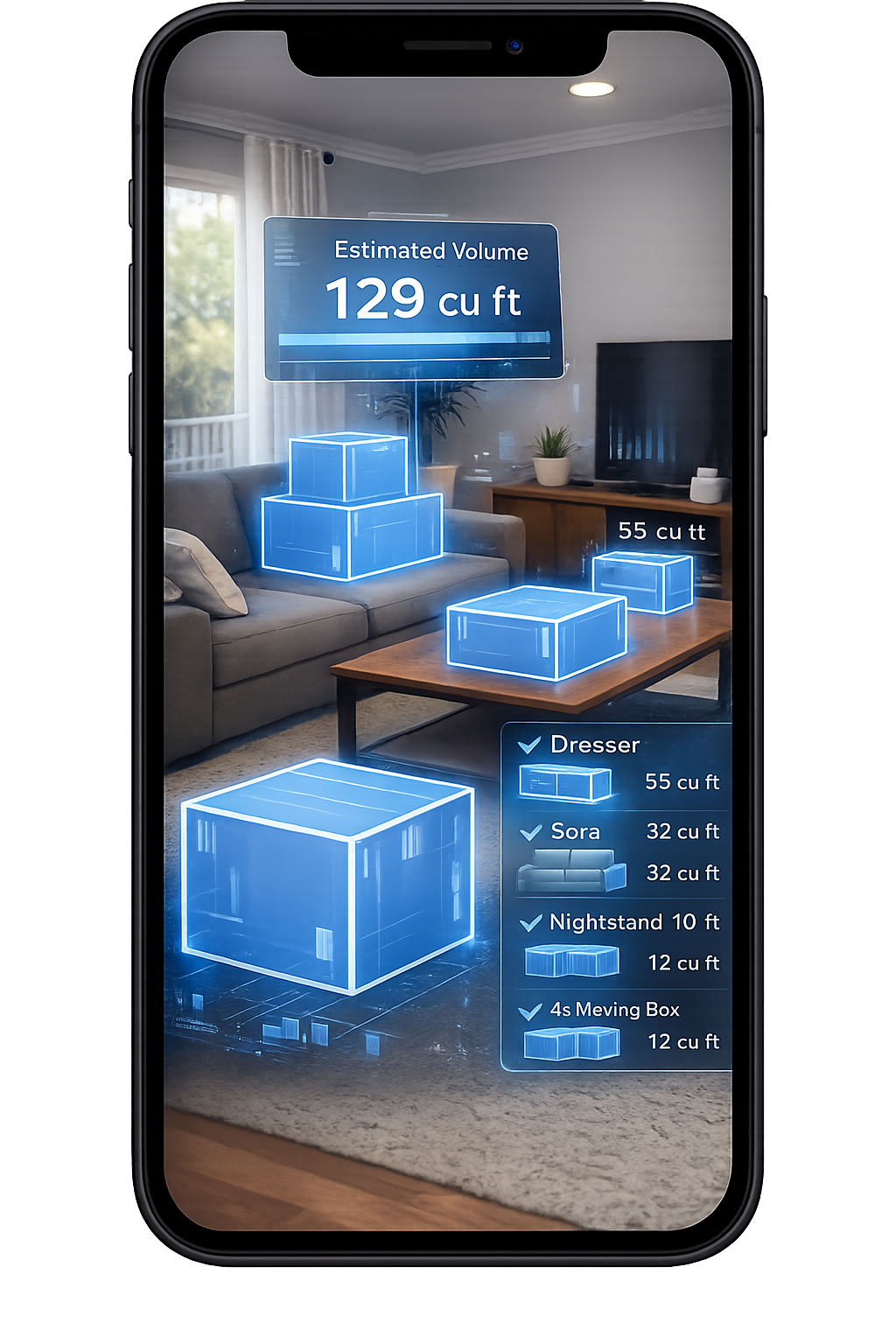
1. Scan Your Room With Your Phone
Walk around your space and scan your items in seconds.
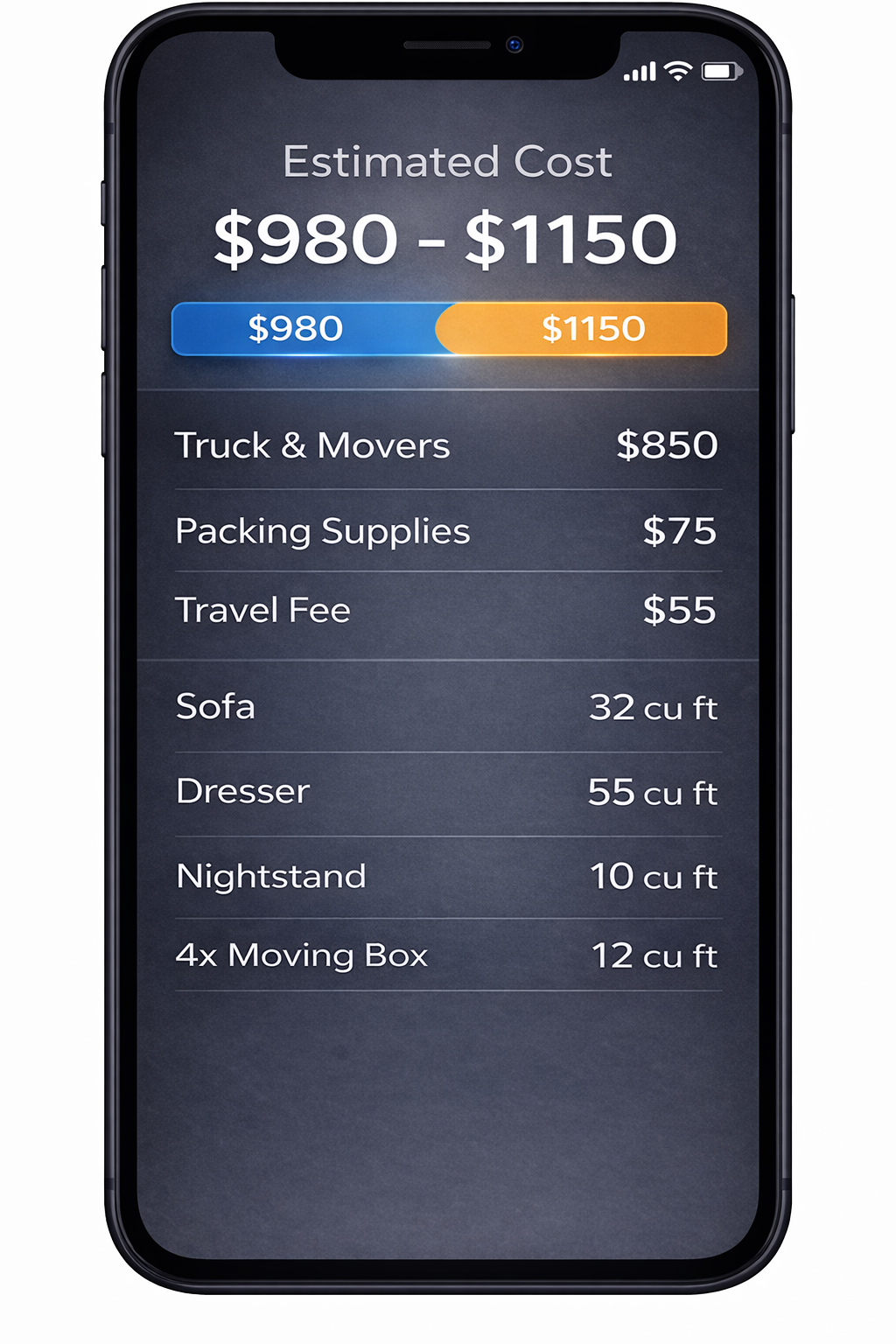
2. AI Detects Your Items
We identify your items and calculate volume for a clearer estimate.
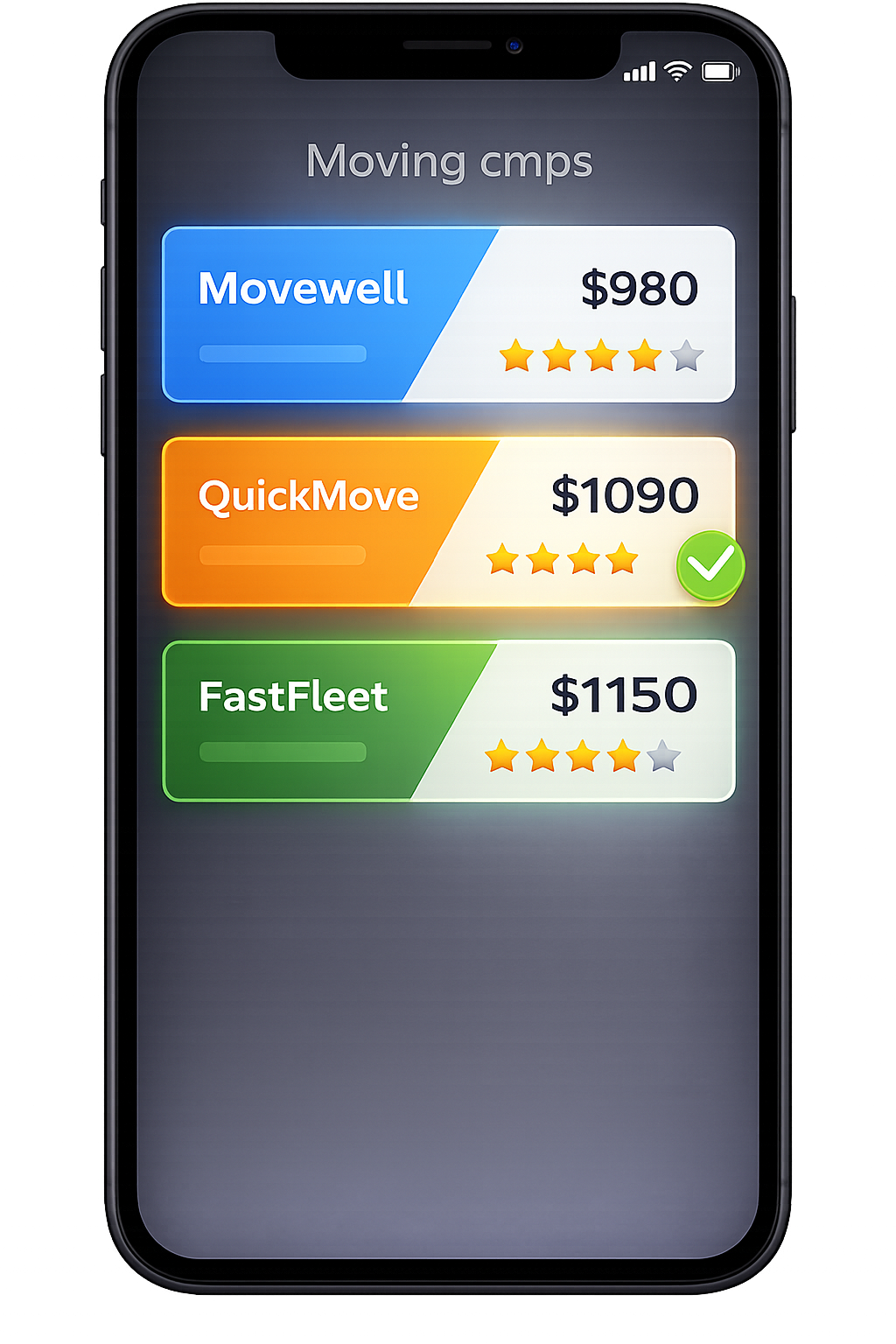
3. Compare Multiple Quotes
Compare mover quotes for Miami, FL from the same scanned inventory.
Frequently Asked Questions
How is this 2026 Miami moving cost page different from the Miami quotes and estimate pages?
This page is the 2026 cost breakdown hub for Miami. It focuses on what realistic prices look like for different home sizes, neighborhoods, and outbound routes, and on which factors usually push your cost up or down. The other Miami pages are more task‑specific: Moving Quotes in Miami, FL is where you use your AI inventory to request and compare actual written quotes from local movers. Moving Estimate in Miami, FL explains the structure of an estimate and how to interpret its line items (labor, truck, access, extras). Local Movers in Miami, FL is about choosing between local companies for short in‑metro moves. Long Distance Movers from Miami, FL focuses on state‑to‑state routes from Miami. Use this cost page first to orient your 2026 budget, then use those other pages when you’re ready to collect and compare real offers.
Is 2026 moving more expensive in Brickell and Downtown than in Kendall or Doral?
Often, yes—for the same amount of stuff, high‑rise cores like Brickell and Downtown tend to be more expensive than many single‑family neighborhoods such as Kendall or Doral. That’s mostly because of access and rules: Brickell/Downtown condos often require freight‑elevator bookings, loading dock use, COIs, and tight move windows. Street and garage layouts can create longer walks from truck to unit. Elevators can add up to many minutes of waiting over the course of a move. In Kendall, Westchester, or Doral, movers can frequently park in a driveway and load straight from door to truck. That can significantly reduce labor time even if the drive across Miami‑Dade is a bit longer. Your AI inventory doesn’t change between these neighborhoods, but your access notes do. MoveCost uses both to help movers price your 2026 Brickell or Kendall move realistically.
What does it cost in 2026 to move a 2‑bedroom condo in Brickell or Edgewater locally?
For a 2‑bedroom condo in a Brickell or Edgewater high‑rise moving to another high‑rise within central Miami in 2026, many local moves fall somewhere in the $800–$1,800+ band, depending on: How furnished the unit is (light vs heavy inventory) Freight‑elevator rules and how long your window is How long the walk is from loading dock or garage to your front door Whether you add packing help or just have movers load and unload Moves with simple access and moderate furniture tend to live closer to the lower/middle range. Moves with tight elevators, long corridors, or especially full units go toward the higher end. Running an AI scan on MoveCost gives local movers a precise list of your items and your access story, which helps them anchor your 2026 Brickell/Edgewater quotes inside those patterns instead of guessing from a generic “2BR, elevator” label.
What about 2026 long‑distance cost from Miami to New York or Texas?
In 2026, long‑distance moves like Miami → New York or Miami → Texas (e.g., Dallas, Houston, Austin) will still be shaped by distance, inventory, access, and season. Illustratively: Smaller 1BR or light 2BR moves that share truck space often land somewhere in the low to mid four‑figure range once all line items are added. Full 3–4BR homes—especially with garage, patio, and balcony items—often move into the higher four‑figure to mid five‑figure band when packing, distance, and access are all included. The State to State Moving Cost Calculator Online page and Long Distance Movers from Miami, FL go deep on route‑specific expectations. This cost hub’s job is to show you that when you cross state lines from Miami in 2026, you’ve moved into a different cost category than a simple in‑metro condo move—and to encourage you to base those decisions on a real AI inventory rather than a rough room count.
How does hurricane season affect moving prices and scheduling in Miami in 2026?
Hurricane season doesn’t automatically make every move in Miami more expensive, but it does add risk and complexity that both you and movers must plan around. In 2026, during hurricane and heavy‑rain months you can expect: More schedule reshuffling when strong systems are forecast Some buildings temporarily pausing moves or limiting elevator use Occasional wider delivery windows for long‑distance routes affected by storms Movers may: Encourage weekday morning slots that are easier to reschedule than packed weekend days Build small timing buffers into quotes when storms are likely On MoveCost, you can mark that your move is in hurricane season and add any building‑specific weather rules you receive. That helps movers quote realistic time ranges and explain in writing how they handle weather‑related changes before you book.
Can I trust national average cost numbers if I’m moving in Miami?
National averages can be a useful starting point, but they hide the very things that make Miami unique: Condo and HOA rules in Brickell, Downtown, Edgewater, Midtown, and along the beaches High humidity and heat that slow work on stairs and long walks Narrow or highly controlled parking in certain neighborhoods This 2026 Miami cost hub intentionally focuses on local examples and route bands rather than broad national figures. You can: Use national guides to understand rough categories (small apartment vs large home) Use this page to see how those categories behave inside Miami Then run your AI scan to replace remaining guesswork with your actual inventory and building conditions
Do I still need a mover walkthrough if I already did an AI scan?
For many standard Miami apartments, condos, and typical 1–3BR homes, an AI scan plus detailed access notes can be enough for movers to give solid estimates and plan the crew. They see what you own and how they’ll reach it. Situations where a mover might still suggest a walkthrough or video call include: Very large homes (4BR+ with extensive storage and outdoor areas) Unusual items like large aquariums, specialty machinery, or art collections Extremely tight or complex building layouts In those cases, the AI scan is still valuable: it becomes the starting point movers use to ask more targeted questions, instead of starting from zero. That usually keeps any additional walkthrough shorter and more focused.