
Compare Moving Quotes in Houston, TX with One Simple Scan
Scan your home once, then compare clear, itemized moving quotes from Houston movers—see how travel time, toll roads, stairs, and services change your price before you decide who to hire.

moving quotes in Houston, TX
One Place to Compare Moving Quotes Across Houston Neighborhoods
When people search for “moving quotes Houston” or “moving company cost Houston,” they usually end up repeating the same story to several different companies. One mover wants a detailed inventory over the phone, another sends a short email with a rough ballpark, and a third says they can’t quote anything until moving day. MoveCost pulls that research into a single workflow. Instead of starting over with each mover, you describe your Houston move once—maybe you’re going from a one‑bedroom in Midtown to a townhome in the Heights, or from a Katy house to something closer to the Energy Corridor. You can add real‑world details like elevator access, loading docks, staircases, and tricky parking situations—things that actually change moving quotes in Houston. From there, moving companies that service your exact route can respond based on the same inventory and access notes. You see their estimated price ranges, what’s included (truck size, crew count, travel fees, basic supplies), and, where available, general quality indicators like publicly visible ratings or experience with similar moves. Instead of disconnected numbers with no context, you get a side‑by‑side comparison of movers who actually handle your type of move—whether it’s an inside‑the‑Loop apartment shuffle or a larger move out toward The Woodlands, Pearland, or beyond. Because each mover is looking at the same core information, your quotes are easier to compare. You can quickly scan how they handle travel time, stairs, and long walks from parking. That makes it simpler to choose the quote that fits how you actually live in Houston, not just the one that looks smallest at first glance.
Example: Comparing 3 Houston Moving Quotes Side by Side
To show how moving quotes in Houston can differ, here’s a simplified example of three hypothetical movers quoting the same local move: a two‑bedroom apartment move from Midtown to the Heights on a weekday. These are not real companies, but the structure of the quotes mirrors what you might see. Same move details for all three movers: • 2‑bedroom apartment, standard furniture and boxes • 3rd‑floor unit with stairs, no elevator • Truck must park on the street with a moderate walk to the door • Weekday morning move, no special building restrictions Mover A: Lower hourly rate, more add‑ons • Base: lower hourly rate for a 2‑person crew • Estimated hours: 5 hours (loading, short Midtown–Heights drive, unloading) • Travel fee: separate charge listed as 1 hour of drive time from the company’s yard to Midtown and back from the Heights • Stairs: stair fee per flight added as its own line item • Supplies: moving blankets included; stretch wrap and wardrobe boxes priced per unit • Toll roads: no tolls expected, local streets only for this route How this quote looks in MoveCost: • Labor subtotal (hourly x 5) • Travel time line item • Stair fee line item • Optional supplies section Mover B: Mid‑range rate, more bundled services • Base: mid‑range hourly rate for a 3‑person crew • Estimated hours: 4 hours (extra mover to speed up loading and unloading) • Travel fee: flat “Houston central” travel charge covering drive time between Midtown and the Heights • Stairs: included in base rate for up to a 3rd‑floor walk‑up • Supplies: blankets and stretch wrap included; wardrobe boxes available at a per‑box rate • Toll roads: none expected, local streets only How this quote looks in MoveCost: • Labor subtotal (hourly x 4) • Flat travel fee line item • Included services section listing stairs and basic wrapping • Optional wardrobe boxes section Mover C: Higher hourly rate, time‑savings focus • Base: highest hourly rate for a 3‑person crew • Estimated hours: 3.5 hours (experienced crew, assumes efficient loading) • Travel fee: flat fee covering Midtown, the Heights, and nearby neighborhoods • Stairs: included, with an extra crew member during loading if needed • Supplies: blankets, stretch wrap, and a limited number of wardrobe boxes included • Toll roads: may use nearby freeways depending on traffic; no tolls expected for this short route How this quote looks in MoveCost: • Labor subtotal (hourly x 3.5) • Flat travel fee • Included services: stairs, some packing materials, extra crew flexibility All three movers are quoting the same move, but the final totals differ because of: • How many hours they expect your move to take • Whether travel time is billed as a flat fee or hourly • How stairs and access are priced (included vs. separate fees) • How much packing material and crew capacity is included. In MoveCost, each of these line items is visible. Instead of a single total, you can see why one Houston quote is higher or lower and decide whether you prefer a lower hourly rate with more extra fees, or a higher hourly rate with more bundled services.
AI Home Scan for Accurate Houston Moving Volume and Costs
Most moving quotes are off because the mover never really understands your inventory or access until moving day. Guess too low and you risk extra charges for extra time or a second trip. Guess too high and you overpay based on a worst‑case assumption. MoveCost reduces that gap by letting you scan your home with your phone; our AI turns that walk‑through into a structured inventory movers can use to build more grounded quotes. Here’s how it fits a typical Houston move: • Walk through your apartment in Montrose or your house in Cypress with your phone camera. • The scan captures major furniture, visible boxes, and larger items like sectionals, king beds, exercise equipment, or a full garage of tools. • You can then add details movers care about but can’t always see in the video: number of flights of stairs, elevator access, parking distance, and any areas where a truck can’t park directly. Houston has plenty of buildings where loading is complicated: high‑rises near Downtown with freight elevators that must be reserved, gated complexes in Westchase with limited visitor parking, and townhomes in EaDo where the truck has to park in an alley. The AI scan lets you mark these details in a few taps so movers know what they’re walking into before they quote. That extra clarity gives you more realistic estimates. Instead of a rough guess based only on your ZIP code and bedroom count, you get quotes shaped by your actual layout, access, and volume. It also saves you time—one scan powers multiple Houston moving quotes, instead of repeating the same explanations with every mover.
How Houston Distance and Toll Roads Affect Moving Quotes
Moving within Houston is not the same as moving in a compact city. The metro area is spread out, traffic is unpredictable, and several toll roads can speed up or slow down your move depending on how your mover plans the route. When you ask for moving quotes through MoveCost, you can specify your exact start and end points—Sugar Land to Spring, Clear Lake to Downtown, an apartment in Greenway Plaza to a house in Oak Forest, or a cross‑metro route like Katy to League City. Movers use this to estimate drive time and choose between surface streets, freeways, and toll roads. On the quote comparison screen, you can see details such as: • Whether a mover uses a flat travel fee for moves within a set radius of central Houston, or bills travel per hour. • How they handle longer cross‑metro routes, like Humble to Pearland, where drive time and traffic patterns can add several hours. • Whether potential tolls for Beltway 8, Hardy Toll Road, or Grand Parkway (99) are included in the estimate or listed as separate, conditional charges. Two movers with similar hourly rates can show very different totals if one expects 2 hours of round‑trip drive time with tolls and the other expects 3 hours on surface streets with no tolls. MoveCost’s goal is to make those differences visible so you can choose the travel structure that makes sense for your schedule and budget, instead of guessing how distance across the Houston metro will affect your moving quote.
Factor in Houston Building Rules, Elevators, and Parking Before You Book
Building logistics are one of the most common reasons Houston moving quotes change between the estimate and the final bill. Inside the Loop and around major employment centers, many apartments and high‑rises have specific move‑in and move‑out rules that can slow a crew down. In MoveCost, you can add building and neighborhood details such as: • Freight elevator reservations in Downtown, the Medical Center, or Uptown • Allowed moving hours in HOA‑regulated neighborhoods in Cinco Ranch, Spring, or Kingwood • Loading dock access near office‑heavy areas like the Galleria or Greenway Plaza • Long walks from a shared garage or visitor parking to your front door • Restrictions on truck size or where a truck can park along narrow streets or gated entries Movers see these notes up front and can: • Adjust estimated hours to reflect slower loading through elevators or long hallways • Decide how many crew members to send on moving day • Plan to bring a different truck size if tight turns or low clearances are involved By putting these local constraints into your quote request, you help movers price more realistically and reduce the risk of surprise fees for extra time, long carries, or rescheduling when a building only allows moves on certain days or during certain windows.
Local and Long‑Distance Moving Quotes from Houston in One Workflow
If you’re weighing different options—staying in the Houston area vs. relocating out of state—you can handle both sets of quotes from the same AI inventory. For local Houston moves, quotes usually focus on: • Crew size and hourly rate • Estimated hours for loading, driving, and unloading • Local travel time across your specific route • Tolls and parking situations, if relevant That framework fits typical moves like: • High‑rise near Discovery Green to a townhouse in East End • Family home in Clear Lake to something smaller in Friendswood • Apartment in Westchase to a house in Katy or Cypress For long‑distance moves starting in Houston, movers factor in: • Total miles and route (Houston to Dallas, Austin, San Antonio, or out of state) • Estimated truck space and weight based on your AI inventory • Possible overnight stops, delivery windows, and whether your shipment is direct or combined with others You can set up separate quote requests—one tagged as a "local Houston moving quote" and another tagged as a "long‑distance moving quote from Houston." Your scan and inventory carry over so you do not need to re‑enter everything, and you can compare the structure of local and long‑distance pricing side by side as you plan.
How to Read a Houston Moving Quote (and Spot Real Value)
When several moving quotes arrive in your inbox, the lowest total can be tempting. In a city as large as Houston, though, the cheapest number can change quickly if the quote underestimates traffic, distance, stairs, or access issues. MoveCost breaks each quote into pieces so you can see what you’re paying for: • Base structure: Is the quote hourly, flat‑rate, or a mix (flat travel fee plus hourly labor)? • Estimated hours: How much time is allocated to loading, driving, and unloading based on your actual addresses and inventory. • Travel and fuel: Whether the mover uses a flat within‑Houston travel fee or bills travel as separate hourly drive time, and whether fuel is included. • Stairs, elevators, and long carries: Whether they’re bundled into the base rate or listed as separate line items that could change if the job takes longer. • Supplies and add‑ons: What’s already included (blankets, basic wrapping) and what will be added if you request it (wardrobe boxes, packing labor, heavy‑item handling). With that breakdown, you can: • Compare a lower hourly rate that assumes more hours versus a higher hourly rate that assumes fewer hours. • Decide whether you’re comfortable with a quote that excludes tolls, or whether you prefer a flat travel fee that already accounts for likely toll routes. • See how different movers treat the same Houston‑specific constraints like 3rd‑floor walk‑ups, long hallway carries, or garage‑only parking. The goal is not to tell you which mover to book, but to make it easier to interpret Houston moving quotes in context so you can choose the structure that works for your budget and timing.
Next Step: Scan Your Houston Home and See Real Quotes
Everything on this page comes back to one simple action: give movers a clear picture of your Houston home once, then compare their responses in a structured way. With MoveCost, you: 1. Scan your home in a few minutes with your phone so movers can see your furniture and layout. 2. Add Houston‑specific details like stairs, elevators, parking, building rules, and likely routes across the metro. 3. Review multiple quotes side by side, focusing on travel fees, tolls, services, and expected hours—not just a single total. From there, you can contact the mover that best fits your route, timing, and budget, or adjust your details and request updated estimates if your plans change. MoveCost is a comparison and guidance tool, not a moving company, so you stay in control of which mover you ultimately choose. When you’re ready, start a free scan and see how different Houston movers price the same inventory, addresses, and building conditions.
How It Works

1. Scan Your Room With Your Phone
Walk around your space and scan your items in seconds.
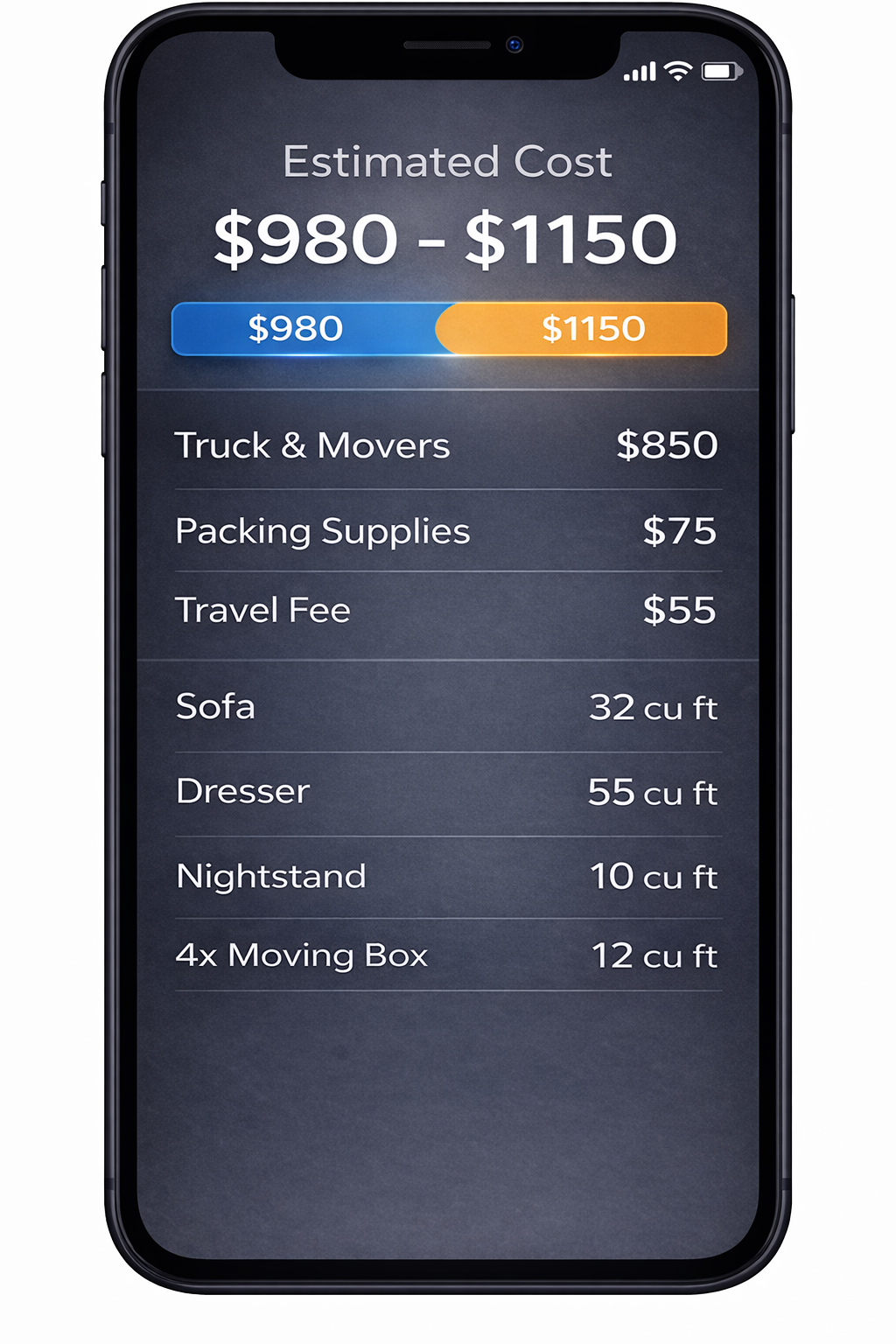
2. AI Detects Your Items
We identify your items and calculate volume for a clearer estimate.
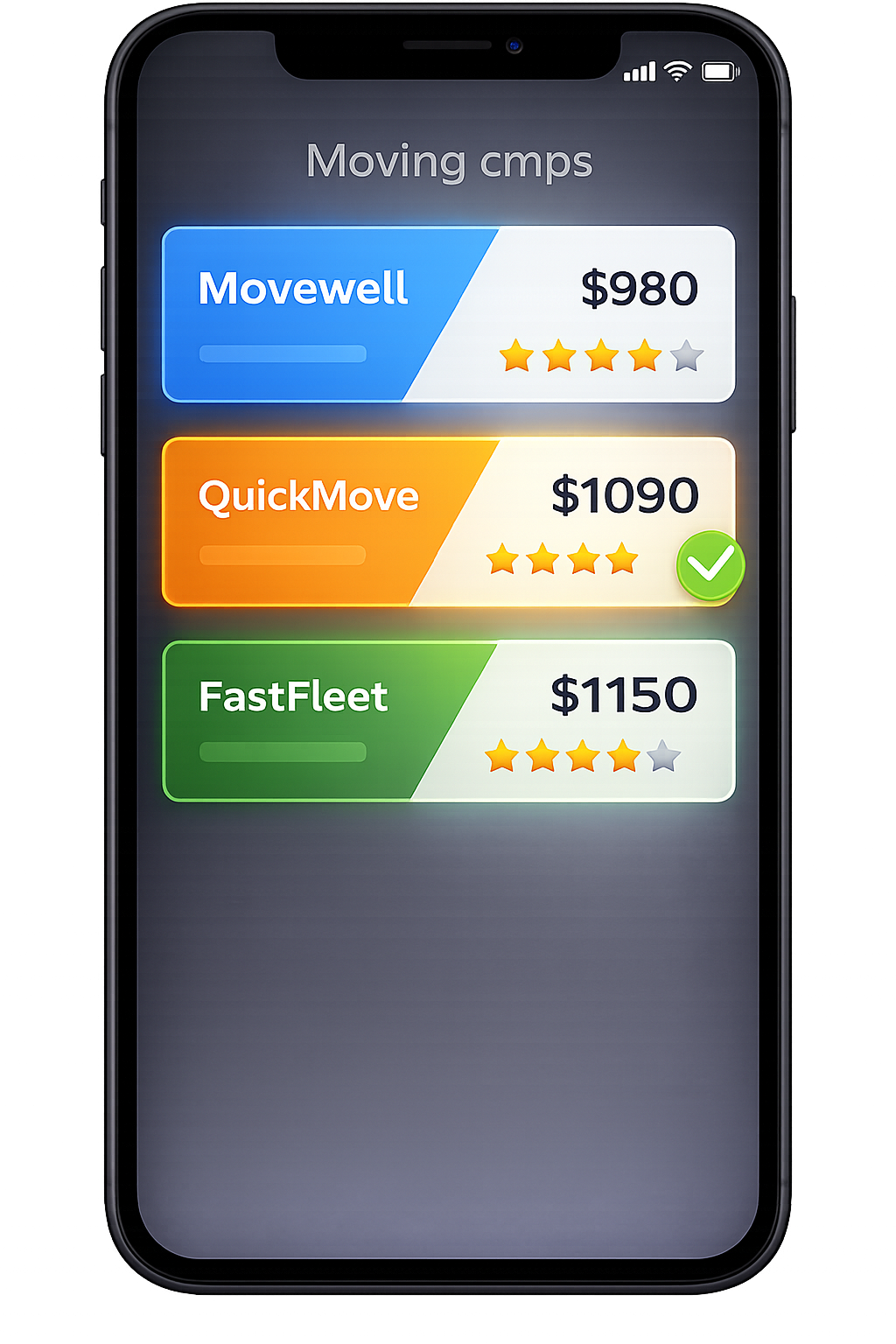
3. Compare Multiple Quotes
Compare mover quotes for Houston, TX from the same scanned inventory.
Frequently Asked Questions
How accurate are Houston moving quotes if I’m in a high‑rise or downtown apartment?
They’re typically more grounded than a quick phone estimate because movers can see the details that matter. When you scan your place and note your freight elevator, loading dock, and parking situation, companies that regularly work Downtown, in the Medical Center, or near the Galleria can price based on realistic effort and time. As long as your inventory and building info are honest—number of rooms, stairs, hallway distance—your final cost is more likely to land close to the estimate, unless you add a lot of items or change access on moving day.
How does distance across the Houston metro affect my moving quote?
Distance affects your quote through drive time and how movers charge for that time. Shorter, inside‑the‑Loop moves (for example, Montrose to the Heights) may have a simple flat travel fee plus hourly labor. Cross‑metro routes like Katy to League City or Sugar Land to Spring can involve more drive time, more time in traffic, and possibly tolls, which can increase estimated hours or the travel charge. When you request quotes through MoveCost, movers see your actual start and end addresses, plan realistic routes, and include their travel approach in the estimate so you can compare how each company handles distance.
Do Houston movers include toll roads like Beltway 8 or Hardy Toll Road in their estimates?
Policies vary by mover. Some include tolls in a flat travel fee for moves within a defined radius, while others list tolls as a separate line item or avoid toll roads unless they significantly shorten the route. If your path is likely to involve Beltway 8, Hardy Toll Road, or parts of Grand Parkway (99), you can mention that in your MoveCost request. When you compare quotes, you’ll see how each mover handles travel fees and, where applicable, toll charges, so you can decide whether you prefer a toll‑heavy but faster route or a toll‑free but potentially slower one.
Can I compare quotes for both a local Houston move and a possible out‑of‑state move?
Yes. Many people deciding on a job change or relocation want to see both options. You can request local quotes for, for example, moving from Pearland to the Heights, and separate long‑distance quotes if you might move from Houston to another state. Set them up as separate quote requests inside MoveCost. Your AI inventory scan is reused for both, so you don’t have to rescan your home. Local movers respond to the Houston‑area request, while long‑haul carriers respond to the out‑of‑state option.
What if my Houston apartment has strict move‑in or move‑out rules?
That’s common in newer complexes inside the Loop and near major employment centers. When you request quotes, MoveCost prompts you to add building details like allowed moving hours, elevator reservations, loading dock locations, and any insurance or certificate of insurance (COI) requirements. Movers see these notes before they quote your job and can plan crews and timing around them, which reduces the chances of last‑minute changes if your building only allows moves Monday–Friday or blocks weekend moves during certain hours.
Is the AI home scan required to get moving quotes in Houston?
The scan is optional but recommended, especially if you have more than a studio or if your place has unusual access—tight staircases, long walks from the parking lot, or shared garages common in many Houston complexes. You can still fill out a manual inventory and request quotes, but the scan typically leads to better‑matched crew sizes and more detailed pricing because movers can see your space more clearly.
How is MoveCost different from a Houston moving company?
MoveCost is not a moving company and does not send crews or trucks. It’s a tool that helps you build an accurate inventory with AI scanning, share consistent information with multiple movers, and compare their quotes in a structured way. You choose which mover to contact and hire based on the quotes you receive. That separation lets you focus on comparing price structures and services instead of committing to a single company before you understand your options.